|
|
|
Archaeology Always
Confirms the Bible |
|
All throughout the 19th and 20th centuries, Bible sceptics have tried to
claim the that the Bible is not a true, historic record just because they hadn't yet found
certain evidences for things written in the Bible. But during this time
the science of
archaeology has proven to be a very valuable tool in better understanding,
confirming and illustrating the Bible. Before about 1800 very little was
known about the events, background, and setting of the Old and New Testament
Scriptures. Therefore, it was nearly impossible to externally confirm the
reliability of the Biblical record. You simply believed it or you didn't. As a
result, it was very difficult to answer the critics' attacks on the historical
accuracy of the Bible. Fortunately, in recent years archaeology has given us
tremendous insight into the culture and lifestyles of ancient peoples. In
addition, our knowledge of ancient history, particularly relating to the Bible,
has been greatly increased. This new information has served time and time again
as an evidence of the reliability of the Bible.
The great value of archaeology has been to show, over and over again, that
the geography, technology, political and military movements, cultures, religious
practices, social institutions, languages, customs, and other aspects of
everyday life of Israel and other nations of antiquity were exactly as described
in the Bible.
As a case in point: King Sargon. In Isaiah 20:1 we read of
Sargon II of Assyria. There he is referred to as "the king of Assyria".
Before modern archaeology, this single Biblical reference was the only place his
name was mentioned in any ancient literature. This fact influenced many
critics to conclude that the Bible was in error on this point, and that there
was no Sargon, king of Assyria, as recorded in Isaiah. The critics were
proven wrong, however, when Paul Emil Botta discovered the remains of Sargon's
palace in 1843.
Of course, the famous
Dead Sea Scrolls provided validation as to the authenticity of the original
Bible scrolls. Whole books can and
actually have been written on the subject. We here provide some exciting
recent discoveries which further confirm the historical accuracy of the Bible.
|
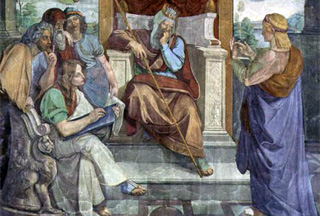 Coins bearing Joseph's name found in
Egypt Coins bearing Joseph's name found in
Egypt
September 2009. A team of Egyptian
archaeologists have discovered ancient coins belonging to the era of
Prophet Joseph bearing his name and image.
Researchers have managed to retrieve 500 coins among a multitude of
unsorted artefacts stored at the Museum of Egypt.
The latest examination revealed that the year in which the coins
were issued, their value or effigies of the then ruling pharaohs
were minted on them.
Several coins belong to a period in which Joseph had lived in Egypt
and bear his name and portrait.
The unprecedented find from the time of the Pharaohs, provides
decisive scientific evidence Joseph was indeed a real ruler in Egypt
at the time the Bible says he was, and disproving previous theories that
ancient Egyptians conducted their trade through barter. |
|
 Nebo-Sarsekim
Found in Babylonian Tablet
Nebo-Sarsekim
Found in Babylonian Tablet
June 2007. Austrian
Assyriologist Michael Jursa was doing what he has done since 1991,
poring over the more than 100,000 undeciphered cuneiform tablets in
the British Museum. But while analyzing records from the Babylonian
city of Sippar, he made a startling discovery with Biblical
implications. It came in the unlikely form of a tablet noting a
one-and-a-half pound gold donation to a temple made by an official,
or "chief eunuch," Nebo-Sarsekim.
Nebo-Sarsekim was a high
Babylonian official named in Jeremiah 39:3. The mention of this
individual in the Hebrew Bible is yet another example of an obscure
“factoid” which demonstrates the historical accuracy and eyewitness
nature of the Biblical record.
The time was the ninth day of the fourth month of the 11th year
of the reign of Zedekiah (Jer 39:2), i.e., July 18, 587 BC. The
place was Jerusalem. The event was the fall of Jerusalem and the
Southern Kingdom of Judah to the Babylonians under Nebuchadnezzar
after a siege of two and a half years, a very sad time in the
history of God’s people. After the city wall was broken
through, all the officials of the king of Babylon came and took
seats in the Middle Gate: Nergal-Sharezer of Samgar, Nebo-Sarsekim a
chief officer, Nergal-Sharezer a high official and all the other
officials of the king of Babylon (Jer 39:3). The Book of
Jeremiah relates that after Nebuchadnezzar took Jerusalem in 587
B.C., he committed the prophet Jeremiah to Nebo-Sarsekim's care.
The tablet is dated 595 B.C., the ninth year of Nebuchadnezzar
II's reign. It was a mundane receipt acknowledging Nebo-Sarsekim’s
payment of 1.7 lb (0.75 kg) of gold to a temple in Babylon. Dated to
the tenth year of Nebuchadnezzar (595 BC), eight years before the
fall of Jerusalem, the tablet reads in full:
[Regarding] 1.5 minas [0.75 kg] of gold, the property of
Nabu-sharrussu-ukin, the chief eunuch, which he sent via Arad-Banitu
the eunuch to [the temple] Esangila: Arad-Banitu has delivered
[it] to Esangila. In the presence of Bel-usat, son of Alpaya,
the royal bodyguard, [and of ] Nadin, son of Marduk-zer-ibni,
Month XI, day 18, year 10 [of] Nebuchadnezzar, king of Babylon
(Reynolds 2007).
The Hebrew spelling of the name is slightly different from the
cuneiform, but there is no question that it is the same person.
Although the NIV translates Nebo-Sarsekim’s title as “chief
officer,” the literal translation is “chief eunuch,” exactly the
same as in the tablet.
|
|
House of David Inscription
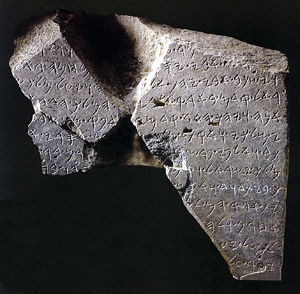 July
1993. More
than a quarter of a century of excavations at Tel Dan in the north
of Israel at the foot of Mount Hermon produced little in the way of
written material. The excavations have been directed through the
years since 1966 by Dr. Avraham Biran, distinguised Israeli
archaeologist. Then on July 21, 1993, while work crews were
preparing the site for visitors, a broken fragment of basalt stone
was uncovered in secondary use in a wall. Surveyor Gila Cook glanced
at the stone in the rays of the afternoon sun and saw what looked
like alphabetic letters. On closer examination it turned out that,
indeed, they had found an inscribed stone.. The discovery was of a
fragment of a large monumental inscription, measuring about 32 cm.
high and 22 cm. at its greatest width. Apparently the stone had been
purposely broken in antiquity. It turned out that the stele fragment
mentions King David's dynasty, "the House of David." As the
preparatory work for tourism proceeded, two additional fragments of
the stele were recovered in two separate, disparate locations in
June of 1994. The partially reconstructed text reads as follows: July
1993. More
than a quarter of a century of excavations at Tel Dan in the north
of Israel at the foot of Mount Hermon produced little in the way of
written material. The excavations have been directed through the
years since 1966 by Dr. Avraham Biran, distinguised Israeli
archaeologist. Then on July 21, 1993, while work crews were
preparing the site for visitors, a broken fragment of basalt stone
was uncovered in secondary use in a wall. Surveyor Gila Cook glanced
at the stone in the rays of the afternoon sun and saw what looked
like alphabetic letters. On closer examination it turned out that,
indeed, they had found an inscribed stone.. The discovery was of a
fragment of a large monumental inscription, measuring about 32 cm.
high and 22 cm. at its greatest width. Apparently the stone had been
purposely broken in antiquity. It turned out that the stele fragment
mentions King David's dynasty, "the House of David." As the
preparatory work for tourism proceeded, two additional fragments of
the stele were recovered in two separate, disparate locations in
June of 1994. The partially reconstructed text reads as follows:
1. [ ... ...] and cut [ ... ]
2. [ ... ] my father went up [against him when] he fought at [ ... ]
3. And my father lay down, he went to his [ancestors]. And the king
of I [s-]
4. rael entered previously in my father's land. [And] Hadad made me
king.
5. And Hadad went in front of me, [and] I departed from [the] seven
[ ...-]
6. s of my kingdom, and I slew [seve]nty kin[gs], who harnessed
thou[sands of cha-]
7. Riots and thousands of horsemen (or: horses). [I killed Jeho]ram
son of [Ahab]
8. king of Israel, and [I] killed [Ahaz]iahu son of [Jehoram kin-]
9. g of the House of David. And I set [their towns into ruins and
turned]
10. their land into [desolation ... ]
11. other [ ... and Jehu ru-]
12. led over Is[rael ... and I laid ]
13. siege upon [ ... ] [6]
The pavement and the wall where the fragments
were found was laid at the end of the 9th or beginning of the 8th
century BC, according to pottery fragments recovered in probes
beneath the flagstone pavement. Since the fragment and the entire
pavement was covered by the debris of the Assyrian destruction of
Tiglath Pileser III, in 732 BC, it could not have been laid latter
than that year.
The surmise is that Jehoash (798-782),
grandson of Jehu, or Jehoash's son, Jeroboam II (793, co-regent
782-753), and more likely Jehoash, was the monarch who had this
reminder of Aramaean domination smashed (2 Kgs 13:25). It is further
assumed that Hazael (844/42-798?) was then king of Aram- Damascus,
because Hazael fought against Jehoram of Israel and Ahaziah of Judah
( 2 Kgs 8:7-15, 28; 2 Chr 22:5). Hazael was followed by his son and
successor, Ben-hadad III, early in the 8th century BC
The discovery provides an archaeological
connection to the biblical references to the ruling dynasty
established by King David approximately two centuries before the
events that are mentioned in the inscription. It is the first
mention of King David and the earliest mention of a biblical figure
outside of the Bible. The discovery is of particular importance in
the face of those scholars who were either skeptical or denied the
historical existence of King David. |
|
When Was the Bible Really Written?

By decoding the inscription on a 3,000-year-old piece of
pottery, an Israeli professor has concluded that parts of the
bible were written hundreds of years earlier than suspected by
non-believers.
The pottery shard was discovered at excavations at Khirbet
Qeiyafa near the Elah valley in Israel -- about 18 miles west of
Jerusalem. Carbon-dating places it in the 10th century BC,
making the shard about 1,000 years older than the Dead Sea
scrolls.
Professor Gershon Galil of the
University of Haifa deciphered the ancient writing, basing
his interpretation on the use of verbs and content particular to
the Hebrew language. It turned out to be "a social statement,
relating to slaves, widows and orphans," Galil explained in a
statement from the University.
The inscription is the earliest example of Hebrew writing
found, which stands in opposition to the dating of the
composition of the Bible in current research; prior to this
discovery, Bible sceptics did not believe that the Bible or parts of it
could have been written this long ago.
According to Israeli newspaper Haaretz,
current theory holds that the Bible could not have been written
before the 6th century B.C.E., because Hebrew writing did not
exist until then. Well, they are now proven wrong.
When will they learn that the scriptures are what they say they
are?
English translation of the deciphered text:
1' you shall not do [it], but worship the [Lord].
2' Judge the sla[ve] and the wid[ow] / Judge the orph[an]
3' [and] the stranger. [Pl]ead for the infant / plead for the
po[or and]
4' the widow. Rehabilitate [the poor] at the hands of the king.
5' Protect the po[or and] the slave / [supp]ort the stranger.
|
|
King Solomon
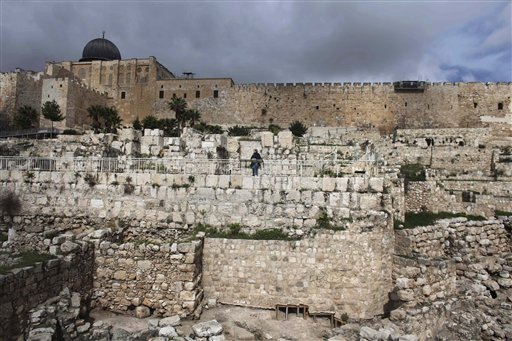 Jerusalem's
ancient fortifications date back 3,000 years to the time of the Bible's King
Solomon and offer evidence for the accuracy of the biblical narrative. Jerusalem's
ancient fortifications date back 3,000 years to the time of the Bible's King
Solomon and offer evidence for the accuracy of the biblical narrative.
|
|
|
 |
|
| For God so loved the world that he gave his one and only Son, that whoever believes in him shall not perish but have eternal life.
--John 3:16 |
|